
Tour Team
The Great Migration Is More Than a River Crossing: Rethinking the Tanzania Safari Experience
The Great Migration is far more than the dramatic river crossings seen in photographs. From the calving plains of Ndutu to the northern Serengeti, discover the natural cycle, wildlife encounters and conservation responsibilities behind one of the world's greatest wildlife spectacles. At Emnel Adventures, we believe the migration is something to understand, not simply witness.
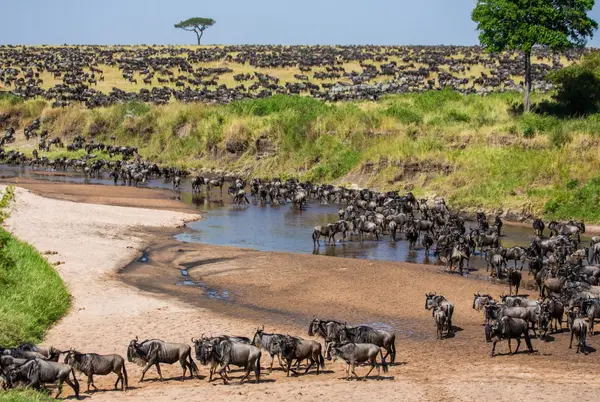
There are few wildlife spectacles on Earth that capture the imagination quite like the Great Migration. Every year, more than a million wildebeest, accompanied by hundreds of thousands of zebras and gazelles, move through the Serengeti ecosystem in search of fresh grazing and water.
For many travellers, the dream is clear: to witness thousands of wildebeest plunging into the Mara River, crocodiles waiting beneath the surface, and the drama of one of nature's most extraordinary encounters.
It is an incredible sight. But is that really what the Great Migration is all about?
At Emnel Adventures, we believe the migration deserves to be understood as something much greater than a single dramatic moment.
A natural phenomenon, not a scheduled performance
One of the biggest misconceptions about the Great Migration is that it is a seasonal event that happens in one particular place.
In reality, it is a continuous natural cycle shaped by rainfall, fresh grazing, water availability and the instinctive movement of wildlife.
From the southern Serengeti and Ndutu plains, where thousands of wildebeest calves are born, to the Western Corridor and eventually the northern Serengeti, the herds are constantly responding to the changing landscape.
The famous Mara River crossings are only one part of this journey.
The calving season offers extraordinary opportunities to witness new life and the intense relationship between predators and prey. The movement through the western Serengeti reveals the sheer scale of the herds, while the northern plains offer the possibility of witnessing the dramatic river crossings.
Each stage has its own character, challenges and rewards.
Understanding these differences is what makes planning a meaningful migration safari so important.
When the experience becomes more important than the spectacle
The popularity of the Great Migration has inevitably changed the way it is marketed.
Photographs of river crossings dominate travel brochures, documentaries and social media. They are powerful images, and understandably so.
But when the entire safari experience becomes centred on capturing one particular moment, something important can be lost.
A river crossing cannot be ordered. Wildebeest may gather along the riverbank for hours or days before moving. They may approach the water and retreat, cross at another location or simply continue grazing.
No itinerary, regardless of its price, can guarantee that moment.
The same is true of wildlife encounters throughout Africa. Nature does not operate according to a travel schedule.
Perhaps the real value of a safari lies in allowing enough time to experience what unfolds, rather than measuring its success against a photograph.
The responsibility of being a visitor
The growing popularity of the migration also brings an important responsibility.
Wildlife areas are living ecosystems, not open-air entertainment venues. The behaviour of visitors and safari vehicles can influence the quality of the experience for both animals and other travellers.
At river crossings in particular, responsible vehicle positioning, patience and respect for designated viewing areas matter.
Tanzania National Parks has established specific guidelines for Mara River viewing, recognising the need to provide visitors with an exceptional experience without compromising the integrity of the ecosystem.
These principles should extend beyond the river crossings.
Giving animals space, avoiding unnecessary disturbance, respecting park regulations and allowing wildlife to behave naturally should be fundamental to every safari.
A good wildlife encounter should never come at the expense of the animal being observed.
The people behind the migration
There is another side of the Great Migration that deserves equal attention: the people whose lives and livelihoods are connected to these landscapes.
Tourism supports thousands of families across northern Tanzania, from professional guides and drivers to camp employees, local suppliers and communities living alongside wildlife areas.
The relationship between tourism and conservation is therefore more complex than simply attracting visitors or reducing visitor numbers.
Responsible tourism must recognise that local communities are part of the future of wildlife conservation.
The long-term value of a safari destination depends not only on the wildlife it protects but also on whether the people connected to that landscape benefit from its continued protection.
For us, this is an important part of what makes locally rooted safari operations meaningful.
Tanzania's wildlife heritage and its people cannot be considered separately.
What makes a better Great Migration safari?
A meaningful migration safari begins with understanding what the traveller hopes to experience and matching that expectation with the right season, region and amount of time.
For someone interested in witnessing the calving season, the southern Serengeti and Ndutu plains offer an entirely different experience from the northern Serengeti during the Mara River crossing period.
For others, spending time in different parts of the Serengeti, observing predator behaviour and following the changing landscape may be more rewarding than concentrating on a single wildlife event.
The right itinerary should allow room for nature to unfold.
It should also be honest about uncertainty. Wildlife movements change, rainfall patterns vary, and sightings can never be guaranteed.
An experienced safari guide does more than locate animals. They help travellers understand their behaviour, interpret the environment and appreciate the wider story taking place around them.
Sometimes the most memorable moments happen when nobody is rushing to the next sighting.
Protecting the experience for future generations
The Great Migration is one of the world's most remarkable natural treasures. Its survival depends on healthy ecosystems, effective conservation, responsible tourism and the continued involvement of the communities who share these landscapes.
As more travellers discover the Serengeti, the industry has an opportunity to do more than sell spectacular wildlife encounters.
We can help visitors become more informed, more patient and more respectful observers of the natural world.
At Emnel Adventures, we believe that a safari should leave travellers with more than photographs. It should give them a deeper appreciation of Tanzania, its wildlife and the people who make these experiences possible.
The river crossings may be among the most dramatic moments of the Great Migration.
But the real story is much bigger.
The Great Migration is not simply something to witness. It is something to understand, respect and protect.
Emnel Adventures – Where the wild speaks, we know how to listen.